

Why the courtyard is on the first floor
In almost every riad in the Medina, the courtyard is on the ground floor. At Kssour Agafay, it is on the first floor. A closer look at a singular feature.
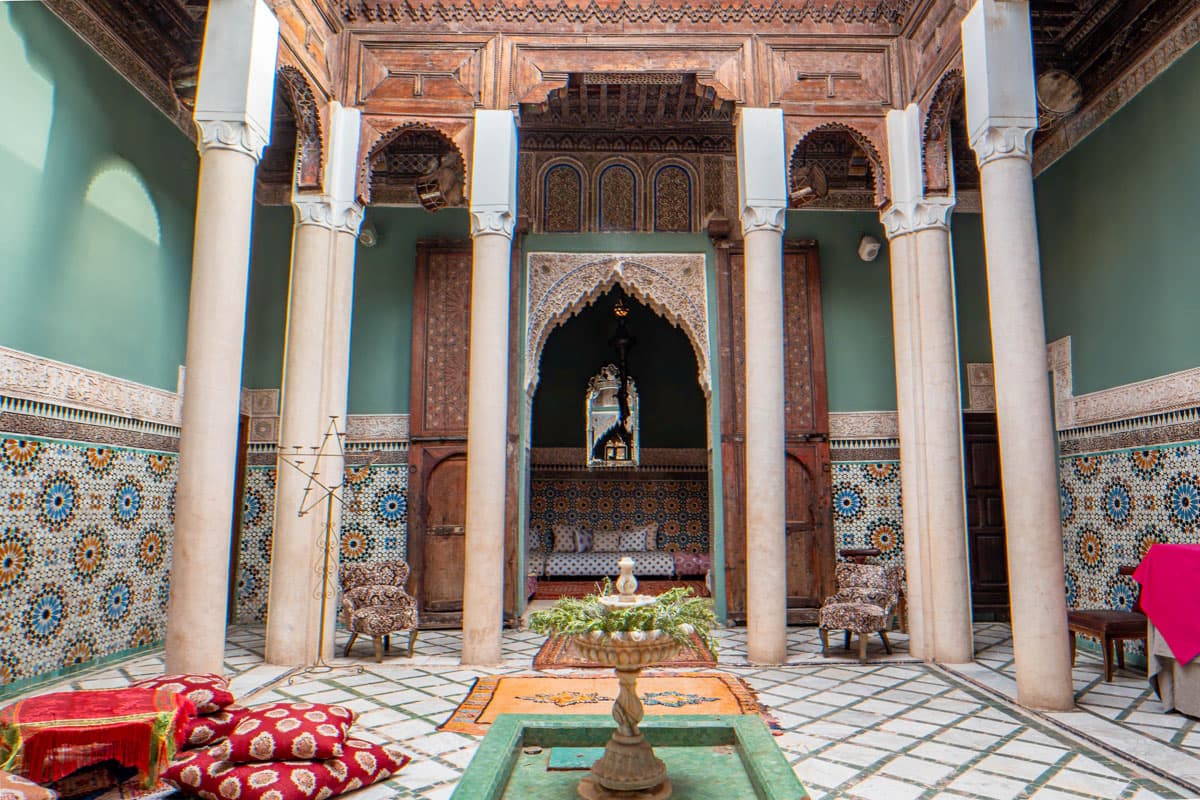
Kssour Agafay is one of the oldest riads in the Marrakech Medina. It also has a distinctive feature that you notice as soon as you arrive: its courtyard is not on the ground floor, as almost everywhere else, but on the first floor.
The riad, a house turned inwards
To understand this singularity, we must go back to what a riad is. The word comes from the Arabic riyad, the plural of rawda, garden. Strictly speaking, a riad is a house arranged around a planted inner courtyard, often divided into four beds around a fountain. A house whose courtyard is not planted is more properly called a dar. In everyday use, the word “riad” now refers to all the traditional houses of the Medina that have become guest houses.
These houses share one principle: they turn their back on the street. On the alley side, an almost blind façade and a door. Behind the door, an angled passage, the skifa, prevents anyone from looking straight inside. Then the house opens all at once onto the courtyard, which gives every room light, air and a view of the sky. It is around the courtyard that the life of the house unfolds.
A courtyard upstairs
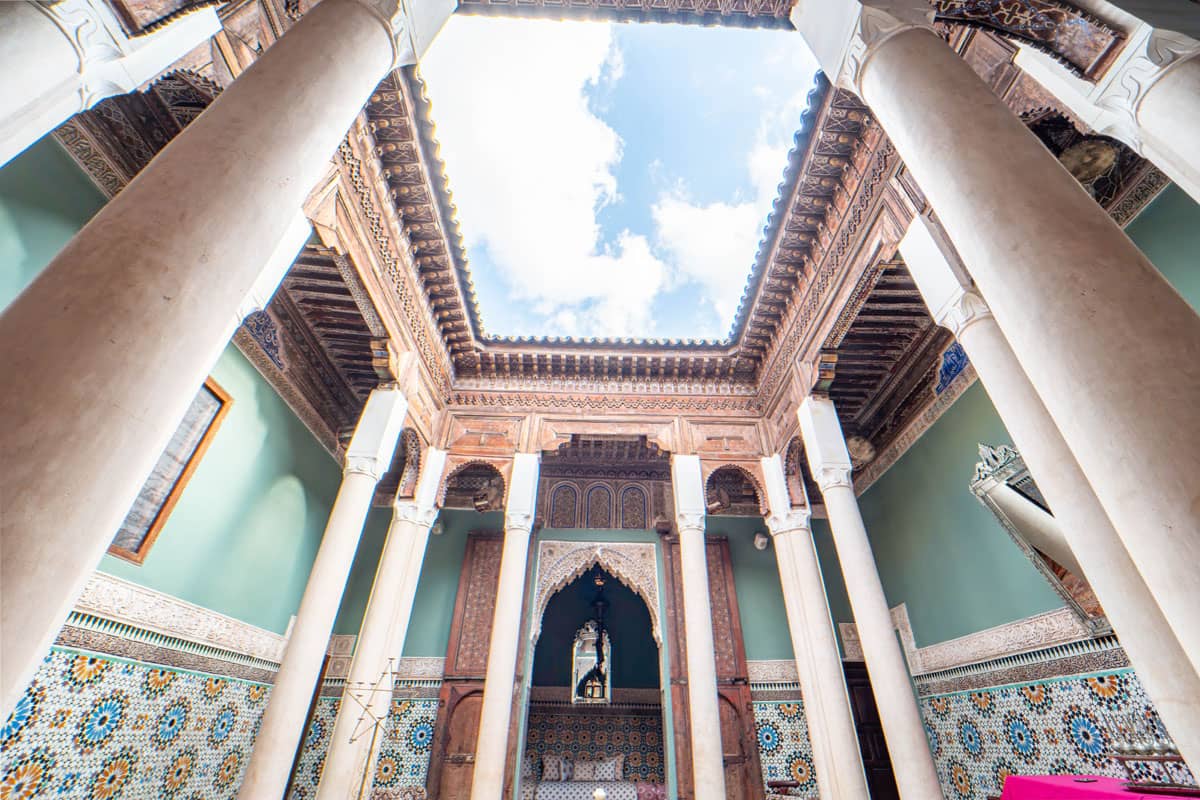
At Kssour Agafay, this courtyard lies on the first floor. You climb up to it from the street, and it is there, above the level of the city, that the house opens out: white columns, carved cedar galleries, zellige walls and, at the centre, a fountain beneath the open sky.
We have found no document that explains this choice with certainty, and we prefer not to invent a legend. What we do know is that the house was built five hundred years ago for a noble family, the Chorfa el Meslohian, as both a residence and a place to receive distinguished visitors. A raised courtyard, removed from the bustle of the alley, lends itself particularly well to that dual purpose.
What it means for you
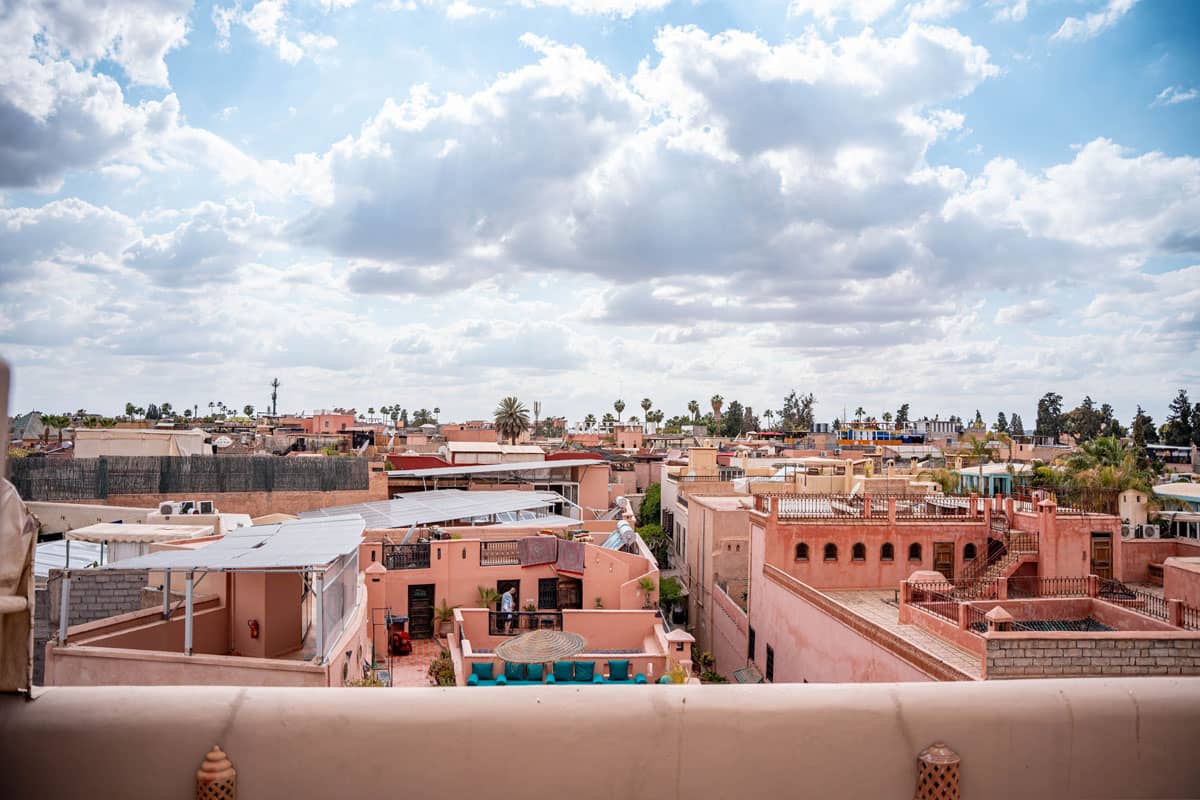
A courtyard upstairs means, first of all, more light. In the narrow alleys of the Medina, ground-floor courtyards often receive little direct sun. Set higher, the courtyard at Kssour Agafay is brighter, and you feel the passing of the hours more keenly.
It also means more calm. The sound of the Medina, close as it is (Jemaa el-Fnaa square is a two-minute walk away), arrives softened. It is a lovely place for breakfast, which can be served in the courtyard, in your room or on the roof terrace.
Finally, it means a different relationship with the sky. Seated in the courtyard, you watch a square of blue framed by the carved wooden galleries. In the evening, when the lanterns are lit, the courtyard becomes an open-air salon.
A 16th-century ensemble
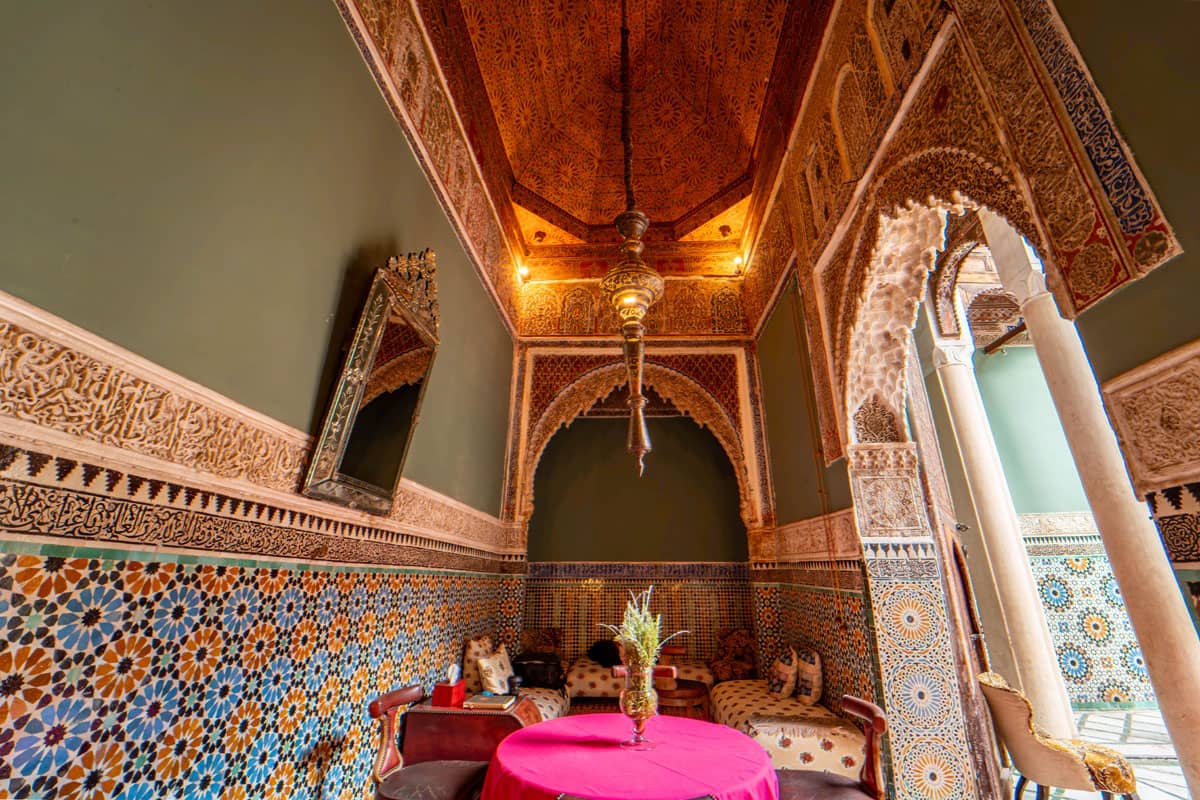
The courtyard is only one part of a remarkable whole. Having fallen into ruin in the 20th century, the house was acquired in 1997 by its present owners, who spent three years faithfully restoring it. It has kept many original features: the painted wooden ceilings, the hand-carved plaster decoration and arches, the walls of finely fitted zellige and doors four metres high.
These crafts are those of Saadian Marrakech, the same era as the Ben Youssef Madrasa, rebuilt and completed in 1564–1565. If you visit it during your stay, you will recognise in its great courtyard the same vocabulary of columns, wood and zellige.
The best way to understand this courtyard is still to spend time in it: in the morning for the light, in the afternoon for the shade of the galleries, in the evening for the lanterns. Discover the riad.
Tags
- Heritage
- Architecture
- Riad
- 16th century